119

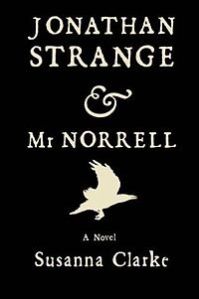
One of the finest fantasy novels I haven’t yet finished reading is Jonathan Strange and Mr Norrell. (The reason why I haven’t is that the book is going with me to the Other City, and so very few books are.) I wonder why there isn’t more conversation/fannishness about this novel among the circles I access. Of course, it’s a story that is painfully slow to unveil its core. There are few stereotypes. The narrative reads like a history text — thorough and unforeseeable. And did I mention ‘thorough’? The construction of the early nineteenth century is so delicious! At the end of Part One I am still sighing with some fondness over Childermass, even though Childermass may not turn out to be the expected Byronic hero or even a character of any consequence at all in the entirety of the narrative.
In other news, today I cleansed my toenails of the remnants of nail-polish that had been chipping away gently for the last two months. The charm of tinting one’s nails continues to evade me. To watch it dissolve and the natural translucence of nail emerge from underneath was an exercise in deep happiness. Now I shall go offline and re-watch the second book of Avatar: The Last Airbender.

113

Snuff, read a couple of days after its date of publication, turned out to be a fun book to read but a difficult book to like. It’s a good story, well-plotted and contains Vimes. It makes me want to never read a Vimes story again. How does one put this rationally? The book is such an unabashed apology for aristocracy that it makes me angry. Makes my blood boil.  Never before had I found a reason to disapprove of any of Sir Pterry’s ways of treating people (and he was the only author I could say that about and Discworld is a long series). I’m no longer quite so sure. I genuinely hope he’s done with Vimes, even though I’ll never be able to like Vimes as much as I used to anymore.

What I’ve always found admirable about Discworld was the incredibly democratic and considerate vision of the series. There are quite a few characters who are born to privilege but they nearly always dazzle you of their own accord — what can you say about people like Vetinari, Carrot, Angua, Verence or William de Worde? Even pre-Snuff Sybil. The genes, the breeding, the money are all implied once in a while but not beyond reasonable extent, they don’t overwhelm the characters. It’s still the people themselves who make the difference. In Snuff, for the first time, the aristocracy fills the sky and everyone else is greatly diminished by it. It’s a story that doesn’t work if Vimes and Sybil are not aristocrats, and I don’t care (that much) about Sybil but since when has Vimes required the power of social privilege to make a story work for him?
Snuff makes me want to run weeping to the arms of the non-YA witch stories — the likes of which Pratchett hasn’t written in a long time (Carpe Jugulum was thirteen years and sixteen books ago) — and never read another thing from Ankh-Morpork again. It breaks the tie between Vimes and Granny Weatherwax as my favourite Discworld character and sends Granny shooting to the top. How I absolutely admire the witches, those formidable third-sighted individuals who come out of complete peasantstock, picking up their lessons through years of hard labour and constant discouraging and fear and suspicion and dislike, and rising above all that to serve the same community that would burn them at stake if it could. Why hasn’t Pratchett written a proper witch novel in so long? (By ‘proper’ I mean those chillingly insightful accounts that take place from Granny Weatherwax’s perspective. The witch-in-the-making stories starring Tiffany Aching are all very cute, I can’t say I don’t enjoy them for what they are, but they can’t even hold a candle to the proper witch novels.) I do wish he writes a witch novel next, although I’m still holding out hope for the abandoned (?) Moist von Lipwig story.

I’m also just a little tired of the recurrence of the noble savage (or savage race, as the case may be) and the psycho killer, but these things demand rant posts of their own. This would be all for tonight.

Day 19: Favourite Book From Your Childhood

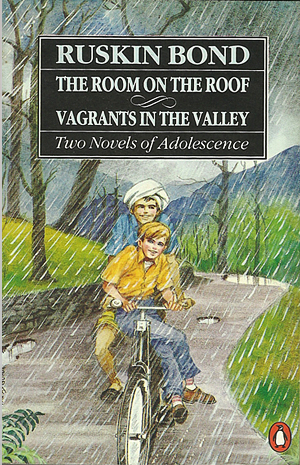
I am about to begin the first day of what may be my last year of college, the last year of being a student, just one more decisive little push away from childhood. Just now I had to take out this book and scan the cover, because there isn’t a good copy of it online, there isn’t even a Wikipedia page; and I had been very particular about wanting to post this cover because this is the image I will always associate with this novel, and the summer vacations at school spent reading about and imagining the Dehra Dun of Ruskin Bond’s stories.

The Room on the Roof by Ruskin Bond

So reading The Room on the Roof was a watershed of adolescence, as Bond perhaps intended it to be. I’d started reading Bond in instalments that came out in TeleKids, back when the children’s supplement of The Telegraph used to be published on Thursdays. Those were the, um… ‘safer’ stories. Growing up, I was entirely unacquainted with books that could be categorized as straightforward romances — sweet and simple boy-meets-girl stories — because my puritanical parents put a blanket ban on anything that promoted ‘that kind of thing’. I never read a Mills-and-Boon at an age when I might’ve enjoyed them. Never watched a Bollywood film at the theatre till I was old enough to watch them with friends. The ideal level of maturity for being excited about Love Story and Gone with the Wind passed me uneventfully by. But my parents didn’t actually look into the content of a book beyond the cover and the blurb, so I ended up reading a lot of potentially risque literature like The Godfather and The Diary of a Young Girl before I even entered high school.
The Room on the Roof was the first of that long list. I remember reading the novel over and over again, trying to come to terms with it, trying to decide if I liked it or hated it, trying to decide if I should like or hate it, wanting to discuss it with someone and never finding the ideal person. (Kids at the school I went to really did not read.) I haven’t returned to this book in more than ten years, but of late I am repeatedly reminded of how great an impression it has left on my mind. I can’t even recall the entire story to details but it keeps resurfacing, it’s like a latent obsession that had never quite gone away. I guess that’s a sign of a book being more than a just a story. More of a memory and an experience.

Day 18: A Book That Turned You On

The collected short stories of pretty much the only female author I enjoy reading, this book is intelligent, fetishistic and sparkling like a treasure chest.

Burning Your Boats by Angela Carter

Angela Carter is a much-theorized author, the kind whose books are put in feminism and queer studies syllabi at universities. Most other authors who share such lists are, honestly, barely readable for the sake of pure fun. They do not like the world as it is. They rebel and complain and scold and sermonize and put the fear of political correctness in you. Most female authors I’ve come across (feminist or not) either tend to scold-and-sermonize, or quietly sidestep gender/sexuality from their subject matter. On the other hand, most erotic writing I’ve come across is intended primarily at men. It makes me squirm to read them. I’m irritated by the casual misogyny and more often than not deeply pained by the quality of writing that’s simply bad. Angela Carter comes along and blasts away all these problems like a raging tornado. The short stories are the best things she’s written, they’re rich with literary (lots of Shakespeare, yay!), historical and mythological references, unselfconscious, guilt-free and intense. There’s no other writing in the world that can quite compare.

Day 17: Your Favourite Book Turned Into A Movie

Admittedly, I am a poor appreciator of cinema. I haven’t always made it a point to watch the film adaptations of the books I’ve loved, and I’ve almost never read up the original novels of some of the films I liked. Of the latter, the best example would be:

A Clockwork Orange by Stanley Kubrick

I love the film with a fervour. I just cannot drag myself through the book, even though I know it’s a masterpiece in its own right. Then again, a ‘book’ doesn’t necessarily mean novel, and there will always be these favourite play adaptations like A Streetcar Named Desire. Of play adaptations, again, Shakespeare adaptations demand a story of their own. (The Shakespeare obsession is, I suspect, an inevitable effect of a training in English literature. When I started college, I was Shakespeare-neutral. Four years down the line, however, I cannot help making a concession for Shakespeare.) Anyway,  if I had to choose one film from the multitude of Shakespeare adaptations, I will (perhaps a little oddly) go with Omkara, which is one of the rare recent Hindi films that I’ve watched and enjoyed a lot.

Omkara by Vishal Bharadwaj

I am very ‘taensh’, but I love Vishal Bharadwaj’s cinema. I love his vision and style and choice of locations and the vitality of his characters, I love his soundtracks, and I’m reminded of Tim Supple’s comment about Shakespeare’s work being ‘messy and wonderful’, which is exactly how this film is.

Finally, at the risk of repeating myself, I cannot possibly conclude a post on my favourite-book-turned-into-a-movie without a mention of this:

The English Patient by Anthony Minghella

The book moved me so much that I can never judge the film objectively, but this is such an utterly beautiful adaptation. I love Ralph Fiennes. I love him a little less for playing Voldemort in the Harry Potter films, but going back to Wuthering Heights and The English Patient always makes me forgive him that crime.