Blog/News

The Clarion West 2016 Write-a-thon and Me: Part 2

I always tell myself that I should be writing, instead of writing about writing, i.e. posts like this. I intended to do a week-by-week update of my Clarion West Write-a-thon, as many others are doing, but we’re already in Week 4 and obviously I haven’t. I also haven’t quite kept to my originally declared writing goals, but I’m happy with myself, since I did write a lot these past three weeks, probably more than I’ve written in a whole year since Clarion West, MFA submissions included. I’ve thought more actively about what I want my writing to accomplish, the perspectives I want to embrace or abandon, and did a little bit of necessary cathartic writing that was blocking my creativity otherwise. I made some writing-related contacts, and I always feel triumphant when I manage to reach out to people, especially strangers, because it never stops being difficult.

I realize that I don’t look like someone who has difficulty initiating conversation with strangers, especially when you judge by my years of living away from home, but I’m actually always winging it. Nearly 95% of the people I know were introduced to me by someone else I knew, or circumstances, e.g. I happened to be in the same office or classroom as them. At almost 29, I feel as terrified of saying “Hi, I am…” as I did when I was 15, if I don’t have the convenient wall of “XYZ asked me to go talk to you” to hide behind. I have zero small-talk skills, so I often lose touch with people when I don’t have anything immediately to do with them. High-functioning anxiety is usually invisible, or gets blatantly called lying, which is the line I’ve got all my life from everyone who doesn’t actually know me closely enough see how I live from day to day.

So for me, every act of initiating contact is an achievement, and I achieved some of those in the last three weeks too, which I hadn’t in nearly a year now, more so because the past year had also been an all-time emotional low. So here’s a list of things that I did for the Write-a-thon till now:

Week 1 (June 19–25):

  • Wrote an essay in defence of fantasy fiction written in India, originally of 2582 words, for a specific publication (TBA) but without a specific pitch or word limit, because said publication doesn’t have them
  • Sent essay to publication
  • Did my final revision on the third story from Other People
  • Sent story to my editor, R. Sivapriya, at Juggernaut Books

Week 2 (June 26–July 1):

  • Wrote a flash/short story
  • Got story beta-read, and edited it
  • Submitted the final version of story for publication
  • Read and critiqued a story by a friend
  • Wrote a grant (well, con membership) application, which has now been achieved! Hat-tip to Con or Bust for their incredible generosity to me. If nothing goes wrong (give an anxious person a break, right?), I may be encountered at the World Fantasy Con in October.

Week 3 (July 2–8):

  • Participated in a Write-a-thon sprint, during which I wrote the beginning of a second essay, intended for a specific publication
  • Completed the first draft of this essay, currently at 1634 words
  • Wrote a semi-personal blog post about an emotional crisis I have been suffering for a while now, 2187 words. (I’m not sure if I should be counting this under Write-a-thon writing, since I am not even seeking to publish it anywhere else, but I had started thinking up a story that involved a traumatizing relationship, and I realized that I could not write that story until I wrote out my own.)
  • Reconnected with an ex-employer who sometimes publishes SFF (there are no dedicated SFF publishers in India), and who may have some freelance writing work for me
  • Wrote a query to a publication (TBA2) asking if they’ll be interested in a third essay I’m hoping to write.


Week 4 (July 9–15):

  • Received response and edited version from editor of TBA publication about the essay from Week 1
  • Did minor rewriting to essay from Week 1 and sent it back

And now we’re halfway through Week 4, and TBA2 publication has written back saying they may be interested in the idea (but not sure, since they’ve never seen my writing before), so I will get on with trying to write that essay. Thinking of it, it hasn’t been such an unproductive Write-a-thon, overall.


Fallouts of a Gaslight Romance

Nine months ago, I extracted myself forcefully from the dregs of a relationship that had lasted, off and on, for two years before that. It left me a seething mass of guilt and self-hatred. He wouldn’t let go. He was stalking me and hurting himself, letting me know at every possible chance what I was making him do. How I had ruined his life. I would be threatening to call the police if he ever contacted me again, and then crying into my pillow, wondering when I had turned into such a nasty bitch, believing that I would never meet anyone to love again, believing I was incapable of love, a psychic vampire, a ruiner of lives, a breaker of the people who tried to love me. Believing I deserved every single bad thing that happened to me, because somewhere the karmic cycle had to give.

The last few months, every time I narrate this story, more frequently to myself than to anyone else, I have swung between calling him a monster and just a guy whom I happened to not get along with though we both tried too hard. He was polite, introverted, but also well-spoken and extremely sharp. Everyone who met him found him nice. His friends – largely consisting of the drunks at the local pub, whom he enabled with his own (not infinite) money when they ran out of theirs – found him nice. His ex-girlfriend – a girl whom I’d never met because she was Romanian, living back in Bucharest, and had no interest in meeting me; and whom he openly called a high-functioning psychopath – found him nice. His mother – who lived in Calcutta at the same time as I did, and also had no interest in meeting me – found him nice. Even the few of my own friends (four, to be precise) who met him briefly found him nice, although he had no interest in furthering the acquaintance.

He voted Labour. Called himself an anarchist. Called himself a feminist. Looked after me when I had chicken pox, my skin all blistered open and oozing pus; then looked after me when I was debilitated with depression, never mind that part of the depression was triggered by him. 

He didn’t want me to go anywhere without him, even to see an innocent tourist attraction in London, even to meet a friend over a cup of coffee, but refused when I asked him to come along as well. (So, basically, neither of us would go.) He was irritated when I talked about my friends. He was irritated when I talked about my writing, my studies, my family, my dreams, anything at all. He was irritated every time I expressed an opinion he didn’t feel equally strongly about, because it’s all very well to have an accomplished girlfriend, as long as her accomplishments are validated by him.  I wasn’t even entitled to have a private thought that differed from his. I wasn’t allowed to have a hobby that he didn’t find exciting (merely didn’t find exciting, not even one that he objected to). Every thought would be pried out, ceaselessly argued, endlessly yelled at, until I would give up and “see the light”, and only then we could go get dinner.

I remember so much yelling, so much yelling, so much yelling. Sometimes I would be too scared to respond to a call, yet not picking up the phone would only make matters worse, because the yelling would only escalate the next time I did pick up. Sometimes I would just zone out, cower in a corner of my brain, and let the noise wash over me. The words no longer made sense – it was all a red, bristling haze. I am the child of an abusive home. I have cowered all my life from loud noises. Sometimes people have difficulty hearing my voice in a conversation, because I have a maladjusted sense of what’s loud enough, and I always go for the lower end of the spectrum. He knew this, just as well as he knew every other bit of my life that he’d forcefully pried out.

But he was a nice guy. He cried too. He tried his hardest to keep me with him. He sent me a bouquet of roses in Calcutta for our one-year anniversary, and another in Seattle for my birthday. This second time we were actually broken up, but he never stopped trying. No other guy would do so much for me.

He was avidly against the Sad Puppies, but when I got through at Clarion West, he told me Clarion West was frivolous and, frankly, useless. Go have fun if you want to, I’d like you to get out of home and be social, but don’t expect to learn any serious writing from that kinda place. Writing is an act of rigour and self-sacrifice. Everything else is shallow self-promotion.

He had been writing a novel for ten years. That monstrous tome of self-obsession was better than anything I would ever write.

He wasn’t the traditional chauvinist. When I got sexually assaulted, he called me dramatic and delusional. Not like your average MCP who’d like to punch the face of any dude who so much glances sidelong at his girl. I should’ve known it when he called the women who had crushes on him dramatic and delusional. Called his friends’ girlfriends annoying when they were tired of nagging their good-for-nothing partners to perform the simplest household chore. Called the woman who winked at him at the pub a rapist. But, to his credit, he never called anyone a slut or a whore. A self-proclaimed feminist doesn’t do that. Fat girls, however, were just lazy and not trying hard enough to deserve nice things. (His worst insult for a woman was to call her an SJW. He yelled at me every time he suspected I might be turning into an SJW.)

He cooked for me. We never went out to eat. We were stuck for hours in the kitchen – him cooking, me keeping him company, because that was the least that I could do, even though I had deadlines, I might want to talk to someone else for a change, I might even want to do something else with him. If I so much expressed the intention, there was yelling.

The yelling, the yelling. There was nowhere to hide from it. My ears wouldn’t stop ringing, my brain wouldn’t stop reeling from the last one before he’d set off again with the next. If we were doing reasonably fine, if there was nothing immediately to yell about, he’d invent one – from the Internet, from the news, from the news five years ago. I could never recover myself well enough to smile. I could never recover myself well enough to want to have sex. (No, I don’t enjoy steamy make-up sex. I run the fuck away from a violent situation.) And then there would be more yelling, because this meant I was sexually inert, because this meant I didn’t love him enough, because I had embedded sexual dysfunctions that I was refusing to address. Yet every time we broke up and I went on to have sex with other people (after those break-ups, each of which felt final, I always, vehemently went on to have sex with other people), the sex turned out to be fun, spontaneous, an earnest and life-affirming respite.

Here I was, dysfunctional, stuck in love with this guy and absolutely without any desire for him. Why would I break up with him, why would I find another person to love, when the problem was inherently with me?

He was two years younger than me. He would grow up, if only I gave him the time.

For two years, I waited for the day I would stop wanting to spontaneously break into tears all the time, because he was such a good boyfriend otherwise. Liberal. Generous. Faithful. Holding down a prestigious job and being a responsible citizen. Genuinely interested in being with me. No one else I’d ever loved had made me so much of a priority.

No one else I’d ever loved had made me so much of a project.

By the time I finally cut him off in November, I could no longer connect with the person I had been before. I had irretrievably changed. I was living on a third continent. None of the people I regularly talked to were the same, except my mother and my best friend – a guy from college whom my ex had tried his hardest to make me quit. It is completely to this friend’s credit that he was right there to listen to me cry for three hours on the phone, at the middle of the night Indian time, on a weekday, when I called him up for the first time in nearly a year. I had quit him – disappeared from his life without notice – although at another end I was ceaselessly fighting for my right to stay friends with him, my right to talk to him, against mounting accusations of emotional unfaithfulness. I had quit my other friends too, and some of them justifiably drifted away.

I extracted myself, and the first thing that hit me was… nothing. The dark, scary void. I didn’t have any friends except that one guy. It’d been months since I stopped seeing my psychiatrist, who was by now halfway across the world. No one I knew in a vague, social sense could fathom what I’d just gone through. I couldn’t even write an article – not just about relationships, but any opinion piece about politics, sexuality, identity, not even a fucking book review, because I was no longer sure of anything I had formerly believed. I could not even copy-edit – even my sense of grammar and syntax had been blasted to its foundations. My diary entries from one day are contradictory to the next.

I tried to flirt with other people – beautiful people, who were nice to me at least at that first acquaintance – and recoiled every time they reciprocated. I remember kissing a stranger at a party, and then coming home the next day, diving under my blanket, shaking and wanting to die. I remember getting an anxiety attack and rushing to the university therapist, struggling to breathe, because a boy who reminded me of him (self-righteous, sarcastic, insistent) said he’d come to see me at a social event that I could not avoid attending. Is this PTSD? Or am I too dramatic and delusional?

I do not recognize this person. No one who has known me even a little bit at any point in my life (besides the last two years) would be able to recognize her. I was always the fighter, always the one who had a grip on her emotions, even if she didn’t have them all sorted out. I had my demons, but I always got the better of them. I externalized my fears and insecurities – the more uncertain I felt about my place in the world, the more I achieved to seal it. I always dodged romantic bullets – I’ve had my indiscretions, but never really let in anyone who felt unwholesome; I believed I had an instinct for it. I feel like I’m talking about a character from a story – none of these characteristics resonate within me any more.

I don’t know who I am any longer. I don’t trust anyone’s validation. Not my several degrees’. Not my psychotherapist’s. The least of all my own.

But of course, I broke up with a really great guy, broke his heart, messed him up. He went and had a brawl at the pub, got himself a black eye. He temporarily quit his highly desirable job. He fucked a random, collateral girl who had a crush on him, and then dumped her when she started being dramatic and delusional – and all of that is my fault. I do not deserve anyone else’s love, because I’ll break them just the same way again, because I’m inherently toxic like that.

The best thing about this entire post is that I don’t even know which parts of it I intend to be ironic. They fluctuate, just like all my other intentions, just like everything else I hold true. I’ll look at it after clicking “publish” and the only thing that will feel true is the last paragraph. Are you supposed to be laughing with me? Are you supposed to be laughing at me? Am I the villain of this entire story? I have no idea. If you try to reach out to me, I’ll probably snap your fingers off. I don’t know what I expect to achieve by posting this, except that I’ve cried my heart out as I typed these words, and I’m hoping one day my reserve of tears will run dry. And maybe when it does, eventually this fog will clear, and I don’t know what I’ll see when it does, but I’ll see something. Seeing something – any one thing – will be good enough. I’m so tired and giddy from always seeing double.

 

The Clarion West 2016 Write-a-thon and Me: Part 1

Last summer, I went to a science-fiction-and-fantasy writing workshop in Seattle called Clarion West. I was the first among my friends in India to apply for this workshop, although I had heard of a couple of Indian writers here and there (famous people, mostly already NRIs, no one I knew personally yet) who had attended it before. I don’t come from the sort of family background that allows me the luxury of attending creative writing workshops abroad, and neither do most of my friends, so that just wasn’t the level I would naturally think at, although I had known vaguely about Clarion West for years. You cannot avoid it, especially if you’re a reader of contemporary international SFF, because so many of the writers are Clarion West graduates (or graduates of the other Clarion workshop in San Diego), and they’re almost always proud enough to mention it in their author bios.

Honestly, I only applied in December 2014 because I already had a writing sample going out for MFA applications, so what was one more application (or potential rejection)? But I also applied because of the generous language on scholarships on the Clarion West website – the fact that they tried their best to fund anyone who couldn’t attend the workshop without funding. The fact that you didn’t need recommendations to apply, only your writing sample, so it didn’t matter who you knew. It didn’t say going there was easy, and I’ve met writers – strong, talented, dedicated writers – who only got into Clarion West on their second or third attempts, but it felt like this was a place that was fair, encouraging, and filled with genuine goodwill towards nurturing new writers.

If you’re a certain kind of naïve idealist (i.e. like me), a lot of places feel like that from a couple of continents’ distance, and then you turn up there and realize that the “real world” is equally squalid and oppressive everywhere – just one structure of discrimination displaced by another – and that marketing language on websites can be very far from the ground reality. One year down the line, I have no such complaints about Clarion West.

I also learned, in a way that you can probably only learn if you go there and see the workings of it firsthand, that goodwill is really the currency that runs this large and prestigious workshop, hard as that is to believe. Clarion West isn’t attached to any university or other organization with a larger funding system. All the generous scholarships are donations, as are often the bedding, fans, edible treats, toys that are given to the workshop attendees every year. Many of the (incredibly talented and famous) teachers and guest lecturers are alumni, who are happy to pass on their knowledge to new students at I imagine a very small fee. Alumni and friends of the workshop who live in and around Seattle open their houses for weekend parties (I attended parties at the houses of Greg Bear and Nicola Griffith), and drop by at the workshop house with free books and other goodies, or often just to carry stuff, offer rides, clean the common spaces and so on. Alumni who live elsewhere send in little things through Amazon or regular courier. A lot of people pitch in whatever they can, and the result is this abundant and nourishing experience that repeats itself every year. No one is an employee. No one earns anything by offering their time, money, resources or expertise to Clarion West, except maybe the good you do in the world multiplies itself, and that is a reward on its own.

In honour of that spirit and that community, which had helped me and made me one of their own – an amateur writer from a different country, a queer female person of colour with very little inherited privilege in the world – this year I’m doing the Clarion West Write-a-thon.

This is a process in which alumni (but also friends of the workshop) set themselves a number of writing goals for the duration of the current year’s workshop, and appeal to be sponsored for their efforts. The money goes to Clarion West, so it doesn’t make a difference which writer you sponsor. It’s not a competition for honour – the participants aren’t set in a hierarchy according to how much money they bring in; in fact, those individual stats are never released. So there are the really big-shot alumni – writers of bestselling books, writers who have taught at Clarion West in turn – setting themselves up for the Write-a-thon, alongside my class who are the most recent alumni, alongside alumni who’ve not even published anything yet. Some writers offer gifts in return to a certain amount in donation, but there’s no minimum amount anyone can donate, because the idea of crowdfunding is that every single dollar (or rupee, or any other currency) helps.

The way this helps the participating writers is that it sets us goals and deadlines, and a lot of us work better with goals and deadlines, given that “real life” is so endlessly distracting. Sometimes we write with more joy and focus when there are others writing along with us, and there are Write-a-thon events happening at Seattle, New York and California where participating writers can meet and share notes. I am very far from all that, spending my summer at home in Calcutta (there’s no reason why there can’t be a Calcutta event, I suppose, except that there aren’t that many of us here, and we didn’t call to organize an event), but the sense of doing something together is largely online and pervasive, the way it used to be for writers who participated in NaNoWriMo. Except that this is even more flexible than NaNoWriMo (which I always felt too anxious to participate in, because a novel in a month, with constant word-count races, just seemed beyond the capacity of a slow writer like me), because each writer chooses their own goals.

The Clarion West Writing Workshop this year is taking place in Seattle between June 19 and July 29. In the last ten days, I have written:

  • one essay on a speculative-fiction-related topic,
  • one experimental fantasy short story, slightly longer than a flash,

both of which are in the publication queue at different venues, so I may be able to share them soon. I have also sent the third story from Other People to my editor at Juggernaut Books, which is likely to be available on the app in August. You can look at my other writing goals, on which I am working, at my Write-a-thon page.

So, I would love it if you go take a look – at my page, but also of the other writers who are participating – and give Clarion West any amount of money you wish for having enabled the writing career(s) of any (or more) of us. These are genuine, earnest, mad talented people, and the fact that they continue to organize this workshop every year – generous scholarships and toys and parties and all – restores my faith that the collective goodwill of individuals can move things in the world. I’m glad to be participating in this year’s Write-a-thon, even though until the last day of sign-ups I wasn’t sure if I was ready for it writing-wise. But at Clarion West you don’t feel judged or discouraged, and my ex-classmates have continued to hold up that tradition, and that kinda thing alone (if nothing else) is worth putting oneself up on the stage for. And maybe, after all, I will end up writing some fun things that some people will enjoy reading. One can always hope.

WisCon 40, OR a Very Nice Ending to One Year in the United States

Actually, if I quit writing in understatements for a moment, it was probably the most perfect and apt ending that this year could have. And now that I’m back home and recovering from jet lag and the overall fatigue of the year, the fact that I spent the last long weekend in Madison, WI, hanging out with a thousand spec-fic people is putting a huge smile on my face, and reminding me why I do what I do.

It’s been almost exactly 12 months for me in the United States. I first landed in America on 18 June 2015. It was on the West coast, in Seattle, where was picked up by Huw from the SeaTac airport and driven (on the right side of the road!) to the Clarion West house, where I was about to spend probably the most enriching six weeks of my life. I left earlier this month, on 1 June, from the JFK airport in New York. I haven’t travelled across the country, but I’ve had a long, eventful year. I went to Philadelphia, Chicago, New York, Los Angeles, Madison. I met a lot of (mostly) interesting people in different places. I was caught unawares and overwhelmed by the generosity of strangers, not-quite-strangers but friends I’ve known only a little, friends of friends whom I had never met. I shared a couple of kisses replete with tenderness and joy. I encountered covert racism and sexism from people who don’t espouse themselves as practitioners of such. I had a lot of remarkable conversations – and, on one occasion, some excellent homegrown weed (Disclaimer: this was in LA; totally legal homegrown weed) – with Uber drivers. I lived through a few dark months of self-hatred and soul-searching, and learned a few things about myself that I didn’t know or acknowledge before.

I wrote a few stories, and a few beginnings of stories.
I wrote a couple of memoir pieces, which I’ve never done before.
I wrote a draft-y poem for a love that had run its course.
I signed a book deal, which wasn’t in the US, but I printed out and scanned back the contract from the printing machine in Armitage Hall, where I had a little office.
I taught a class; admittedly, not with the greatest enjoyment.
I packed up and moved out of an apartment on my own.

Neil Gaiman wished me a happy birthday over Skype in July, which I don’t think he’ll do again this year, but well.

One’s first year in a country is always long and eventful, but I think my first year in the US has been much richer in experience than my first year in the UK. In the UK, for the longest time, I lived in the furthest interiors of a remote Scottish campus that was off the highway from a deadbeat town. Then I shifted to London, and lived with a partner who – for all his good qualities (of which he had many) – was aggressively unwilling to be social. I travelled a lot in my UK year, mostly out to Europe (Germany, Luxembourg, Hungary, Spain), but also to Oxford, Canterbury, Wales, Manchester, but I met fewer people, did fewer things that I’d never done before, and nursed different delusions about myself.

WisCon was the fourth con I’ve ever been to. The first three were all in England – DiscworldCon and WorldCon in 2014, then EasterCon in 2015 (I also went to the Hay Festival in 2014) – but con-going experience is very different when you don’t know anyone, and no one knows you. The ex-boyfriend and I attended a lot of panels. We played games with strangers at DiscworldCon; he chatted with and got books signed by his favourite author at WorldCon; there was that hilarious story of (literally) running into George R.R. Martin, but mostly what we did was hang out with each other, and discuss with each other the new things we’d seen and heard, and then go home. WisCon was very different from all that.

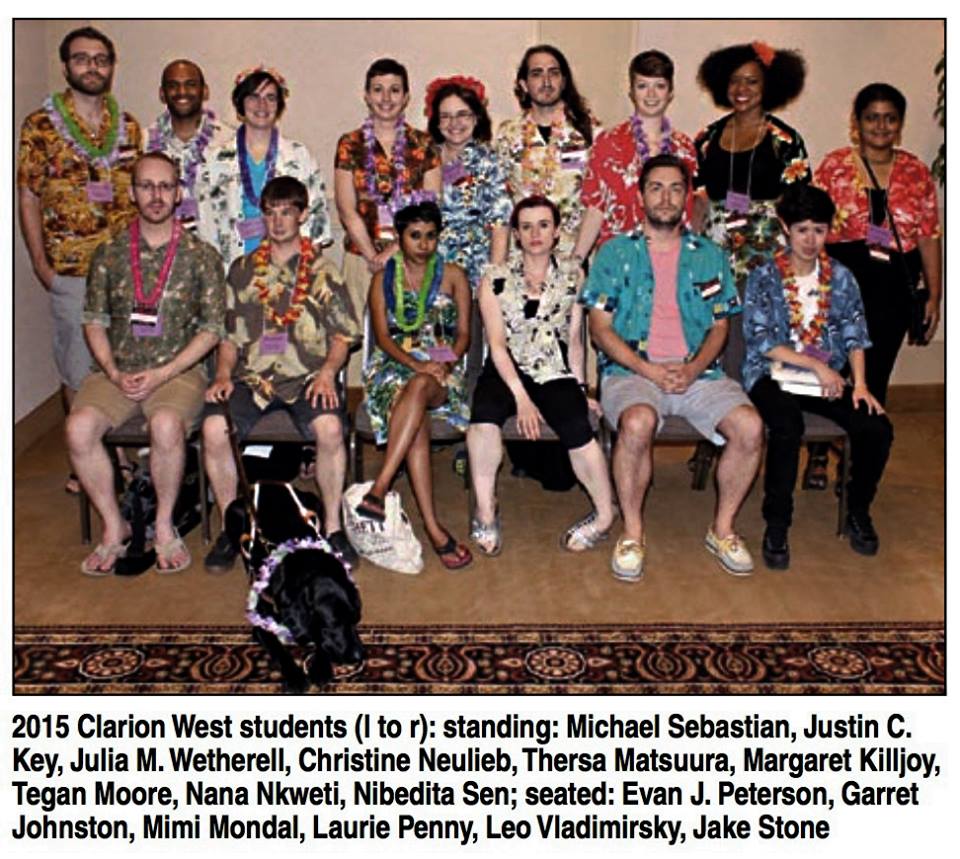
This time I went with friends: Julia, Magpie and Nibs from my Clarion West class. This time I knew a few people. I had started running into people going WisCon-wards right from my stopover at Minneapolis, so even before it officially started, it had begun to feeling like a large festival, a pilgrimage. The people I knew introduced me to other people. I had breakfasts and lunches and dinners and dances and ice-cream walks and 2-a.m.-cigarette-hunts with lovely and interesting people I’d never met before. (I was also aggressively propositioned by a stranger inside an elevator, but this was not a con attendee, and well, real life always finds a way to intervene.) I felt validated. I felt like I didn’t need to feel validated, which is an even nicer way to feel. I felt my brain engaging at its 100% capacity, zero indifference, which is probably the nicest way to feel, and beats every other emotion. Even my body felt rested and healed, almost energetic, even though it was a complete wreck. 

Since Clarion West ended last August, I felt like I was gently drifting out of touch with the speculative fiction community. The world of the MFA is very allied to “mainstream” writing; and Philly has a few spec-fic people, including my friend and Clarion West classmate Christine, but obviously everyone’s on their own schedule, as I was on mine. There was too much real life and too little nerding out all these months; and while real life isn’t essentially a bad thing, there’s that thing they say about too much of anything. I almost didn’t go to WisCon this year – I stayed around in Camden for a month after my classes ended; I missed two buses on the night I left and nearly failed to catch to my flight to Madison – but I’m glad it worked out. I’m glad I made it. I’m glad I now have other directions to go. It has been a good year. 

OTHER PEOPLE has started publishing from Juggernaut Books!


Earlier this year (on 29 February, specifically, because what other more appropriate date for a book about weirdoes?), I signed a contract with Juggernaut Books for my short story collection Other People. Last week, along with the rest of the first list of Juggernaut Books, the first two stories came out in India.

Other People is a collection I’ve been writing for a long time. I started writing “Other People”, the first story, for my creative writing class at Jadavpur University in 2009. It was supposed to be just one story, but it expanded into a whole world and a cast of characters I loved, and I was so lost in exploring them that I never finished writing the story for the deadline that was breathing down my neck. I wrote another story in that world – a simpler but anachronistic story – for a later submission, but then I kept the project aside for a later time when I could develop it more fully.

Life happened. MA happened. Working at Penguin India happened, followed by Scotland, London, many other thoughts, places, people.

In late 2014 I picked up that world again, dusted it off a little, and started writing more stories in it. I loved it still. Older by five years and made a little wiser by life, unleashed into the world from my cloistered existence at home, I felt like I understood this world better, could see the characters clearly, why they were unlike the people who surrounded them, where they were coming from. In 2009 I was only looking at these people from the outside, observing like a visitor; in 2014 I was finally in the midst of them. Inside their heads – where I wanted to be.

I wrote two stories at home in Calcutta – the first two stories that you can read now. I wrote another at Clarion West, Seattle in the summer of 2015, and two more at Rutgers University–Camden, where I enrolled for an MFA now. I am writing another story as I write this post. Other People is a work in progress. The stories will keep appearing from Juggernaut as I write them, and after a while we will have a whole book.

The reason why Juggernaut Books can publish Other People as a serial is that their primary platform is an app. The Android app is out in India already, and the iOS app is soon to follow. (My mother, who has an ancient Windows phone from Nokia, feels a little excluded from the party.) They are new, and they have a fantastic team – probably the best team in India I could publish with right now. Chiki Sarkar, who is the publisher, was my employer back at Penguin India; and R. Sivapriya, who is now my editor, was a senior colleague I was always too much in awe of. (She used to curate the literary classics and translations list back at Penguin India. How many languages does Sivapriya read in? We junior copy editors back at the office could never stop speculating.) They enjoy literary fantasy, which not many publishers in India do yet. The monsters and other outcasts of Other People feel like they’re in safe hands with them.