Blog/News

I have a review! – On File 770

Do you regularly Google yourselves? I still find it awkward to do that, so the only times I end up doing it is on the occasional end-of-the-night/early-morning when I can’t fall asleep but am too tired to do something else more fun. (This doesn’t happen often. There are always more Buzzfeed quizzes to do, which is always more fun than Googling myself.) And that’s how I found out that there was a little one-paragraph review of my Harry Potter essay on File 770 back in December.

This is cool, because File 770 is cool. This also feels more reasonable than the five or so comments that the article got on the original site, all at different points of the scale between splaining and trolling. Online abuse still manages to make me flinch, probably because I haven’t often “put myself out there” in the truest sense of the term, even though I have existed on the Internet for more than a decade. (I existed in networks and communities that were accountable, and in which online identities often led to real-life people.) In the public sense, I am not easily trolled, partly because I absolutely disappear from the site of trollage, refusing to engage. But in the private sense, I also end up wasting an unnecessary amount of time wondering about the kind of human beings who spend most of their life saying unpleasant things to people on the Internet, and what evolutionary turn has brought us to this.

Anyway, here’s a screenshot of the File 770 review, because I would like to keep a record:

screen-shot-2017-02-22-at-4-30-13-am

I hope I am not beginning to seem like the obnoxious celebrity who retweets every praise, which is apparently a stereotype, someone pointed out to me recently. This may be helped by the fact that I’m not, in fact, a celebrity. That essay was my only non-fiction publication last year, and this probably my only review. That’s totally okay to feel great about.

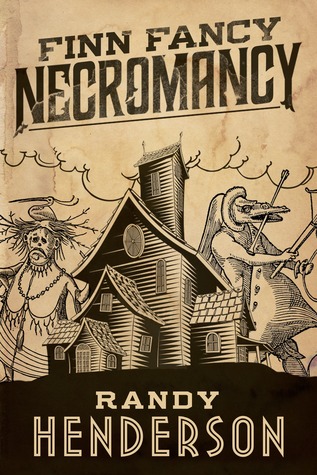
Book Review: Finn Fancy Necromancy by Randy Henderson (Tor, 2015)

Finn Fancy Necromancy by Randy Henderson was the first new book I finished reading in 2017. It took me under 36 hours, most of those hours badgered by the low-frequency headache and full-body heaviness that is characteristic of the recovering-from-flu. Not the best condition for reading a book, but this book cheered me up.

I met Randy in Seattle the summer of 2015, when I was attending Clarion West. He’s a workshop alumnus and resident of the city, and I suppose one of the people whom every new class of Clarion West gets to meet. Besides writing, reading, critiquing, learning, Clarion West is also a very fast, overwhelming blur of meeting people. I must have met at least a hundred people in those one-and-a-half months? And all of them very friendly and welcoming, all of them readers and nerds, many of them talented writers, quite a few of them with books. I’m sure I met and spoke to more people that summer than I actively recall even now. But Randy stands out in my memory as being nice and generous, an attentive listener when you spoke to him, even if the two of you only been introduced in a whirlpool of people at an event. I remember other people being excited and appreciative of his book, which was only a few months out at that time. I didn’t get around to buying the book at the time – if I’d started buying books at CW I would never stop, and then would have ten bags to lug back to India – but I put it on my to-read list. It took me almost two years to get to that, but I’m glad I did, and this is why.

My relationship with humorous writing can be most accurately described with the clichéd expression “love-hate”. Discworld, my favourite literary work of all time, happens to be humorous fantasy. It is also the only thing I can read and re-read when I’m sad, sick, or just completely disappointed with the world. But I’ve also hated – well, at least didn’t get particularly excited about – most other humorous writing that my friends enjoy. It’s in the small things. The pitch of the humour doesn’t resonate with me: I dislike it. The underlying assumptions and politics of the authorial voice don’t resonate with me: I dislike it. The jokes are too obvious: nope. It’s pretty hard to make me laugh, I agree. Which is why it’s also pretty special.

And doing humour well is especially special in a fantasy plot, because the story itself requires be solid in many other aspects and generic conventions that do not run parallel to humour/comedy – suspense, wonder, terror, bravery being just a few of those. I was pleased to find Finn Fancy Necromancy cover all those bases well, while managing to be funny all the way through.

The way Randy achieves this balance is by putting the humour in the first-person narrative voice. The narrator, Finn Gramaraye, is a man who was exiled beyond his body when he was fifteen years old, and returns when he is forty, so his responses to life are still of a fifteen-year-old, although he must perform the role of an older man. What’s better: this boy also happened to be a nerd. He’s a guy who’d be fun even without being magically special, someone with whom a reader may be friends at school, which is probably not true of characters like Harry Potter or Artemis Fowl, and that really makes a difference. When Finn notices a Star Trek reference inches away from getting killed in horrible ways, that touches a chord of familiarity. He comes back after twenty-five years and really just wants to eat pizza. He’s excited that his favourite TV shows have new seasons to watch. But in the background (or rather in the foreground), there are also immense, crazy, heartbreaking, world-changing things going on.

Another thing that I really admired in the book was the absence of casual, normalized misogyny, even though there were plenty of scope to put that into a character who’s stuck as a fifteen-year-old boy from the ’80s. Casual misogyny was normal for the average fifteen-year-old boy in the ’80s; hell, it’s normal for the average fifteen-year-old boy even now. And I suppose that’s where I can see the Clarion West training and superior nuance in perspective coming out: your character doesn’t have to be whatever is the norm for their demographic, even without that being a major plot point or a didactic lesson. Finn is awkward and inexperienced with women, but just happens to not be a jerk, happens to not be a homophobe, as I’m sure some people have been at all times, just not in the popular imagination. And I’m really glad that Randy puts in the work (and the awareness) to make him so, because I would’ve stopped reading the book if he didn’t.

What I found wanting is that, because of the pace and the unpredictability of the plot, I did not manage to grow an attachment to any other character. The perspective is a bit too much inside Finn’s head, and he has come back to life after twenty-five years and immediately learns someone is trying to send him back, and there is just too much going on at both the sensory and the paranoid levels to focus clearly on any other character. When Finn isn’t marvelling modern gadgets and the Internet, or how the local towns have changed, he’s torn between getting romantically involved both of whom he wanted to date as a teenager, but neither of whose lives from the years in between he has any idea about. He alternatively likes and suspects each of his family members, and there are quite a lot of them. The entire action in the 378-page novel takes place in a span of three days, and that’s a bit too fast, both for the narrator/protagonist and the reader. There’s a twist towards the end when the antagonists are revealed, and the surprise hits the reader a little less than it ideally should, because we didn’t know those characters well enough in the first place to be surprised by their turning.

Nevertheless, Finn Fancy Necromancy got me through my sick days with a smile and the occasional chuckle, and I plan to stick with it. The second book in the trilogy, Bigfootloose and Finn Fancy Free, came out in the US in early 2016. It goes into my to-read list right now, and when I’m done with it, you can expect another review.

166

I didn’t intend it to be so, but this blog often has the lowest priority among the things I write, and usually I end up having  more things to write than I have the time for. Still and all, it’s a new year, and I recently moved to New York City, and many things all over the U.S. are changing, so a new post won’t be too amiss.

I finally started editorial work on Letters to Butler, and that means going through about 50 submissions in the space of about a week. I am also trying to write a thesis, a few assignments left over from the last semester, and job applications, so writing is pretty much the only thing I do these days. Sometimes I take a break from writing coordinated things, and write a rambly Facebook post instead. Or vent/document my life in my diary. Or try to plot a random one-shot flash story to write, completely unrelated to my thesis. Guess I am a woman with a limited skill set.

I have a small, warm room, a massive comforter, a well-stocked supermarket next door, and no daytime engagement as of now. These things help.

It has not yet sunk in that I am actually done with classes at Rutgers, and that may have finally been the last time I participated in a classroom as a student. The last semester was breathless. Looking back it feels impossibly long, but I didn’t even notice how fast it flew by, which only speaks for the heavy compression, I suppose. In October, I went to Lenox, MA, and the next week to Columbus, OH for the World Fantasy Convention, where I spoke on three panels and did a solo reading. I entered a new relationship, which following my last experience of a relationship, was (and continues to be) a slow and tentative process of reminding myself how to accept and return love. For every single day that the new relationship doesn’t disintegrate, I consider an achievement unlocked.

I am anxious about the future, but I’ve come to terms with the fact that I’m the sort of person who is always anxious about the future. The very few times in my life when I could clearly see how my next two/three/five/ten years would be, I have discovered myself to be unsettled by the certainty and uncomfortable with it – having everything already in place made me feel walled in. I am hoping this realization about the self is a step in progress, so that I can allow myself to stop feeling anxious about being more anxious than the next person, after all.


Seeking Submissions for LETTERS TO (OCTAVIA) BUTLER

Octavia Estelle Butler was born on 22 June, 1947, and died in 2006. In celebration of what would have been her 70th birthday in 2017, and in recognition of Butler’s enormous influence on speculative fiction, and African-American literature more generally, Twelfth Planet Press is publishing a selection of letters written by science fiction and fantasy’s writers, editors, critics and fans.

  •  We are looking for letters addressed to Butler, between 1000 and 1500 words.
  • We are paying 5c per word up to $USD75 for letters and $USD125 for essays, to be paid on publication.
  • We are looking for World First Publication Rights in English, and exclusivity for the first twelve months of publication.
  •  The deadline for submissions is 8 January, 2017. Twelfth Planet Press plans to publish the volume in time for Butler’s birthday on the 22nd of June 2017.

The editors are Alexandra Pierce, editor of the award-winning Letters to Tiptree and co-host of the Hugo Award-winning podcast Galactic Suburbia, and Mimi Mondal, 2015 recipient of the Octavia E. Butler Memorial Scholarship at the Clarion West Writing Workshop, whose debut short story collection Other People is upcoming in 2017.

The Clarion West 2016 Write-a-thon and Me: Part 3 (Unfinished)

The Clarion West 2016 workshop is ending today as I write (in one of the westernmost time zones of the world, so there are a few hours), two days before it had ended last year, and there’s the end of the Write-a-thon.

I feel a little disappointed in myself.

The imposter syndrome is strong in me. I often write very little, and panic that maybe I’ve run out of imagination; and when I do write a lot, I convince myself that the quality of something written in such bulk can possibly not be very high.

did write a lot in these 1.5 months. I didn’t write 40k words, like I declared on my Write-a-thon page, but I never actually believed I’d write 40k words – that was just to aim as high as I could, so that I got somewhere in the middle. I think I wrote about 25–30k words, and some of them are never going to be published, but that’s not a bad word count. That’s definitely a higher word count than what I’d churned out at the actual workshop last year.

I wrote through days of depression and frequent panic attacks, through a barely trickling Internet connection, and an MS Office crash between Week 4 and Week 5.

Except that I keep thinking I could do better.

Anyway, now I should put up an update for the last two weeks, because sometimes listing out the things you’ve done reminds you that you’ve done enough:

Week 5 (July 16–22):

  • My essay on Indian fantasy fiction from Week 1 got published in Scroll.in! This should actually be a Week 4 update, but I didn’t notice the publication until later. The title of the essay isn’t mine (obviously!), and also obviously you don’t see 2,582 words there, since Scroll.in decided to publish only a section of the original essay. I will probably publish all of it somewhere else – or on this blog – after the Write-a-thon is done.
  • My (older) short story “The Sea Sings at Night” got reprinted in Digital Fiction Pub! Once again, should be a Week 4 update – both of these were published on the same day, in fact – but once again, I didn’t notice until later. This had a remarkably quick turnaround. I think I’d made the submission during the Write-a-thon period itself, although it’s 3.19 a.m. and I’m half-asleep and all these words are too generic and I can’t find the email confirmation for submission now.
  • Received EXTREMELY POSITIVE response from the editor of TBA2 publication about the 842-word first part of Essay 3 (this being an essay on Harry Potter), which I had submitted in Week 4.
  • Proceeded to write complete first draft of the Harry Potter essay, currently at around 4,000 words.
  • Received one more approval from TBA2 publication about said first draft, which I didn’t read until this week, because my Internet connection started being problematic.

Week 6 (July 23–29):

[Ugh, it’s very late, so I’ll finish this post tomorrow. Or something. Just want to publish it already, this being the last day of the Write-a-thon, and all.]