I wish to have a cat named William just so that I can call it Billy.
Blog/News
110
Last evening, after getting lost in the labyrinths of Jodhpur Park (which we still miraculously manage after living in this city all our lives), R and I emerged on a street lined with shops where I spotted a small poster stuck in front of a hardware store — it was a battery ad I had copy-written at the office where I worked in summer. That hadn’t been the most fun campaign I worked on but finding it there, actually finalized and printed and put out in the world, filled me with that familiar feeling of speechless smug excitement that’s characteristic of the firstly published. Like remember the time your sappy little love poem got published in a corner of the fifth page of the newspaper supplement that no one reads? And even if they did happen to read it, the person next to you on the morning metro would still have no clue that you were Mondakini Mojumdar, India’s next Nobel-Laureate-in-Literature standing breathing nibbling at the corner of her ticket right there by their side; but that only goes on to make you feel a little more superior than the ignorant masses, a little closer to Superman as he bides time in his Clark Kent clothes. I thought all these things at once, so evidently I couldn’t spare the thought to take a picture.
This summer kept me happy. Work came by just when I was beginning to dread of a month of stupor and (inevitable) brooding, and the work was educative and fun. I loved the ambience of the office — my first office and very different from the kinds of offices I’ve grown up watching my parents work at. The day I joined, everyone was busy painting the papercups they drank coffee in. The day Google came up with a musical doodle, someone at office played it all afternoon. Other people played virtual pianos and music on Youtube, people made pen sketches and watercolour portraits, people flung bad puns and half-baked jokes across cubicles, went for cigarette breaks in the landing and walks in the rain, fed puppies downstairs and often stayed back all night to say hello to deadlines. I went to sea for three days with L, S and T and it was a welcome break, overwhelmingly peaceful and transcendental in parts. I immersed myself in it all and missed university life very little. Now that I am back I can sense the orbit of detachment that’s grown around me. I’m folding up like a spaceship ready to leave. I have dropped my ballast and secured the living quarters. Last summer when I was given a shot at leaving I was not yet through with university, but by summer next year I will be truly done.
Day 19: Favourite Book From Your Childhood

I am about to begin the first day of what may be my last year of college, the last year of being a student, just one more decisive little push away from childhood. Just now I had to take out this book and scan the cover, because there isn’t a good copy of it online, there isn’t even a Wikipedia page; and I had been very particular about wanting to post this cover because this is the image I will always associate with this novel, and the summer vacations at school spent reading about and imagining the Dehra Dun of Ruskin Bond’s stories.
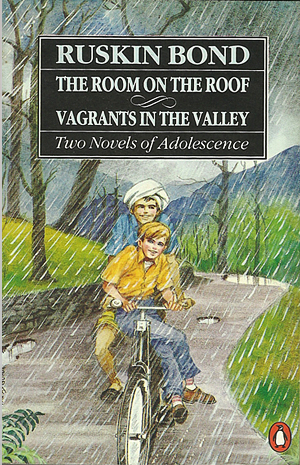
So reading The Room on the Roof was a watershed of adolescence, as Bond perhaps intended it to be. I’d started reading Bond in instalments that came out in TeleKids, back when the children’s supplement of The Telegraph used to be published on Thursdays. Those were the, um… ‘safer’ stories. Growing up, I was entirely unacquainted with books that could be categorized as straightforward romances — sweet and simple boy-meets-girl stories — because my puritanical parents put a blanket ban on anything that promoted ‘that kind of thing’. I never read a Mills-and-Boon at an age when I might’ve enjoyed them. Never watched a Bollywood film at the theatre till I was old enough to watch them with friends. The ideal level of maturity for being excited about Love Story and Gone with the Wind passed me uneventfully by. But my parents didn’t actually look into the content of a book beyond the cover and the blurb, so I ended up reading a lot of potentially risque literature like The Godfather and The Diary of a Young Girl before I even entered high school.
The Room on the Roof was the first of that long list. I remember reading the novel over and over again, trying to come to terms with it, trying to decide if I liked it or hated it, trying to decide if I should like or hate it, wanting to discuss it with someone and never finding the ideal person. (Kids at the school I went to really did not read.) I haven’t returned to this book in more than ten years, but of late I am repeatedly reminded of how great an impression it has left on my mind. I can’t even recall the entire story to details but it keeps resurfacing, it’s like a latent obsession that had never quite gone away. I guess that’s a sign of a book being more than a just a story. More of a memory and an experience.
Day 18: A Book That Turned You On

The collected short stories of pretty much the only female author I enjoy reading, this book is intelligent, fetishistic and sparkling like a treasure chest.

Angela Carter is a much-theorized author, the kind whose books are put in feminism and queer studies syllabi at universities. Most other authors who share such lists are, honestly, barely readable for the sake of pure fun. They do not like the world as it is. They rebel and complain and scold and sermonize and put the fear of political correctness in you. Most female authors I’ve come across (feminist or not) either tend to scold-and-sermonize, or quietly sidestep gender/sexuality from their subject matter. On the other hand, most erotic writing I’ve come across is intended primarily at men. It makes me squirm to read them. I’m irritated by the casual misogyny and more often than not deeply pained by the quality of writing that’s simply bad. Angela Carter comes along and blasts away all these problems like a raging tornado. The short stories are the best things she’s written, they’re rich with literary (lots of Shakespeare, yay!), historical and mythological references, unselfconscious, guilt-free and intense. There’s no other writing in the world that can quite compare.
Day 17: Your Favourite Book Turned Into A Movie

Admittedly, I am a poor appreciator of cinema. I haven’t always made it a point to watch the film adaptations of the books I’ve loved, and I’ve almost never read up the original novels of some of the films I liked. Of the latter, the best example would be:

I love the film with a fervour. I just cannot drag myself through the book, even though I know it’s a masterpiece in its own right. Then again, a ‘book’ doesn’t necessarily mean novel, and there will always be these favourite play adaptations like A Streetcar Named Desire. Of play adaptations, again, Shakespeare adaptations demand a story of their own. (The Shakespeare obsession is, I suspect, an inevitable effect of a training in English literature. When I started college, I was Shakespeare-neutral. Four years down the line, however, I cannot help making a concession for Shakespeare.) Anyway, if I had to choose one film from the multitude of Shakespeare adaptations, I will (perhaps a little oddly) go with Omkara, which is one of the rare recent Hindi films that I’ve watched and enjoyed a lot.

I am very ‘taensh’, but I love Vishal Bharadwaj’s cinema. I love his vision and style and choice of locations and the vitality of his characters, I love his soundtracks, and I’m reminded of Tim Supple’s comment about Shakespeare’s work being ‘messy and wonderful’, which is exactly how this film is.
Finally, at the risk of repeating myself, I cannot possibly conclude a post on my favourite-book-turned-into-a-movie without a mention of this:

The book moved me so much that I can never judge the film objectively, but this is such an utterly beautiful adaptation. I love Ralph Fiennes. I love him a little less for playing Voldemort in the Harry Potter films, but going back to Wuthering Heights and The English Patient always makes me forgive him that crime.
 Mimi Mondal
You must be logged in to post a comment.